
A validating charter
On Freemasonry and the contradictions of liberalism

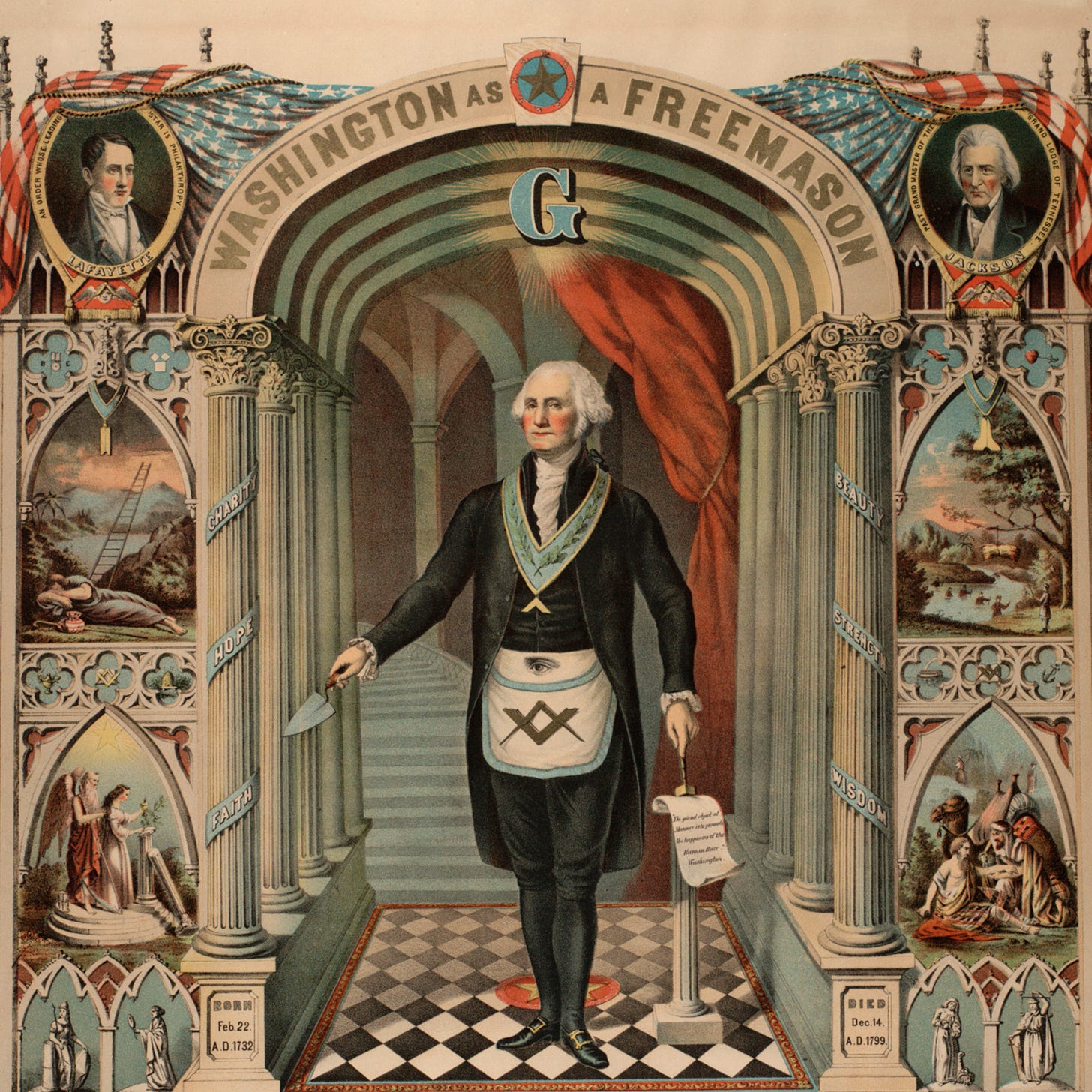
I would like to begin with a public apology. If you have seen me socially any time in the past year or so, there’s a good chance that I’ve spoken to you at length about the Freemasons.
I’m so sorry. It would appear that I’ve fallen victim to “testosterone autism,” the debilitating medical condition identified by Olga Tokarczuk, whereby men of a certain age develop an obsessive interest in, for example, the Third Reich or the Civil War as their social and cognitive faculties decline.
But as I’m always quick to argue (again, sorry everyone), I might be obsessed with secret societies, but not in a weird way. I’m not out here claiming they’re a race of lizard people who live off the blood of Christian babies. Neither does their own mythology bear close scrutiny. According to the “speculative histories” of the Masons, they trace their origins from Medieval craft guilds to the Knights Templar (as Belbo says in Foucault’s Pendulum, “If somebody brings up the Templars, he’s almost always a lunatic”), and from there all the way back to the builders of Solomon’s Temple, or possibly to ancient Egypt, or the cult of Pythagoras, or the people of the Antediluvian Earth. The central ceremony revolves around a pantomime of the murder of an apocryphal architect named Hiram Abiff, credited by the Masons with having designed the Temple of Solomon.
But, as the historian John Dickie reveals in his book The Craft: How the Freemasons Made the Modern World, the true history of the Freemasons is a lot less fantastical but quite a bit more interesting (assuming that your interest is in social history and not pseudo-historical kitsch). Freemasonry came into being as a private men’s club somewhere around the early 1600s, rooted in the liberal values of “religious and racial tolerance, democracy, cosmopolitanism and equality before the law.” But it took its modern form after a meeting in a pub called the Goose and Gridiron in 1717 (the early lodges were each named for the pubs that they met in, such as the Crown and the Rummer and Grapes). The organization’s elaborate mythology was developed piecemeal over the ensuing decades, serving in part to satisfy a popular taste for colourful hokum, and in part for a deeper purpose: that of rendering new ideas more palatable by dressing them in ancient costume.
In Religion and the Decline of Magic, Keith Thomas reveals a similar dynamic at work in the politically turbulent 16th Century, when spurious “ancient” prophecies cropped up again and again to justify and embolden all manner of peasant and noble rebellions, the Reformation and Counter-Reformation, and both sides of the English Civil War. “What these predictions did,” Thomas claims, “was to demonstrate that there was a link between contemporary aspirations and those of remote antiquity.”
Prophecies, therefore, were not simple morale-boosters: they provided a ‘validating charter’ (to adopt the anthropologists’ phrase) for new enterprises undertaken in the face of strong contemporary prohibitions. They justified wars or rebellions and they made periods of unprecedented change emotionally acceptable to those who lived in them.
Freemasonry was never intended as a political movement — in fact the discussion of politics and religion was forbidden in the lodge. But it came into being during a revolutionary time, at the dawn of the Enlightenment and the birth of capitalism, and its absurd biblical mythology played an important role in laundering new ideas in the authority of age.
It was only some sixty years after that meeting at the Goose and Gridiron that the United States declared its independence. George Washington, a committed Mason, “led a campaign to deck American public life in Masonic trappings.” In a nation that had enshrined the separation of Church and State in law, Washington believed that the rituals and symbolism of Freemasonry could lend a unifying meaning to American public life. Masonic brothers led patriotic marches, dedicated new civic buildings, and even organized the state funeral of Washington himself.
Freemasonry’s principles were universal: self-betterment, and the brotherhood of all men regardless of birth or status. Such ideals harmonised with the United States of America’s inborn sense that it stood for something bigger than its own particular national identity, that it was the bearer of universal truths like the ones proclaimed to be self-evident in the Declaration of Independence.
Contrary to its claims, Freemasonry was a revolutionary organization. But the revolution that it spread was a social and not a political one. The same social and economic pressures that gave rise to the American Revolution also created the need for a space like the Lodge to exist.
The dawn of the Enlightenment saw the slow collapse of the ideas and institutions that gave life meaning under medieval feudalism. At a time when modern ideas about individual freedom and democracy had yet to develop, The Masonic Lodge gave progressively-minded men of the rising bourgeoisie and the fading aristocracy the opportunity to meet together at a formal level of social equality, to forge new bonds of patronage and reciprocal obligation, and to experiment in private with new ways of relating to each other that were rooted in new ideas and new identities. Thus the Lodge became the incubator of liberal society and the progenitor of the new ruling class that would eventually lead it.
But the role of American Freemasonry as “a patriotic liturgy” was to outlive Washington by no more than a few decades. In a small New York town in 1827, investigations into the disappearance and suspected murder of William Morgan, a disgruntled former Freemason, revealed a convoluted conspiracy involving a small army of collaborators throughout the community. The ensuing scandal precipitated a massive anti-Masonic backlash in which, “between the late 1820s and the mid-1830s, there was an estimated two-thirds drop in Lodge membership across the nation.”
In retrospect, what’s surprising is not so much that Freemasonry failed to hold onto the role that Washington envisioned for it, but that he thought it appropriate to offer such a role to a secretive private men’s club with a closed membership. In Batavia County, the site of the Morgan scandal, the demographics paint a picture of the kind of unequal situation that must have developed all over the country:
Ninety per cent of the workforce in the county was employed in agriculture, yet 80 per cent of Masons in Batavia and nearby towns worked in the professions. Moreover Masons, who were at most 5 per cent of the population, held 60 per cent of the county’s public offices. The Craft was an invaluable networking hub for the merchants, attorneys and doctors who were the county’s natural political class: in a rural society, they were the only people with the time, money and education to engage in the contest for office. But to anti-Masonic protestors, it looked as if a shadowy clique had control of their world.
For good or ill, the feudal society that Freemasonry helped to supplant was one in which everyone knew their place. It was a system of absolute formal hierarchy, in which a clear chain of obligations stretched upwards from each individual directly to the King himself. Liberalism established a new order, in which a new elite justified their rule by appeal not to divine right or their innate qualities, but to principles of universal liberty.
But if all men are created equal, some are created more equal than others. In a nation whose founding documents simultaneously declare the inalienable rights of Man and the exact fractional value of the life of a slave, the fate of American Freemasonry illustrates the same foundational hypocrisy. The Masons could not become the civic church of Washington’s imaginings without opening their membership to the whole of society. But to do so would be to fatally undermine the unstated but far more significant purpose of becoming a Freemason, which is to take advantage of an exclusive network connected to the ruling elite.
Today, liberalism is so hegemonic that it’s not clear that anything exists to challenge it. But the social revolution that Freemasonry helped to inaugurate has become a victim of political liberalism’s success. In line with the trends in engagement with community groups, churches, and membership associations of all kinds, membership to the Freemasons has collapsed by 75% since 1959. Travel through any town in America today and you’ll encounter the crumbling remnants any number of colourfully named fraternal organizations: the Knights of Pythias, the Odd Fellows, the Benevolent and Protective Order of Elks. Today, these once proud monuments to the quaint absurdity of the American male are being converted into boutique hotels and cocktail bars. Their regalia, plundered like loot from the ancient temples they claimed relation to, hang on the walls as decorative kitsch.
Liberalism is a philosophy rooted in the freedom of the individual, but it spread through networks — secret societies, political parties, professional organizations — whose members derived their sense of self from their affiliation to those groups. Now those communities have collapsed, and liberalism has never felt at once so unassailably dominant and so fragile. We cannot live as isolated economic maximizers: we must produce meaning for ourselves, and not just money. Without a validating charter, what can make our era emotionally acceptable to we who live in it?